Personal Stories
Arnhem's Quiet Flank: The Poles Who Crossed the Rhine
General Sosabowski's 1st Polish Independent Parachute Brigade arrived at Arnhem four days late, dropped on the wrong bank, and were ordered into a crossing that amounted to a death sentence. They went anyway.
Walking in Their Footsteps
Author
October 5, 2026
6 min read
## The General Nobody Wanted to Listen To
Major-General Stanisław Sosabowski had doubts about Operation Market Garden from the moment he was briefed on it at the end of August 1944. The plan, he felt, was too optimistic, too dependent on things going right, too cavalier about the distances involved and the time it would take ground forces to relieve the paratroopers dropped at Arnhem. He said so, clearly, to the British officers who briefed him. He was thanked for his input and the plan proceeded unchanged.
Sosabowski commanded the 1st Polish Independent Parachute Brigade — some 1,500 men who had been training in Britain for years, burning to return to the fight for a homeland that was, by September 1944, being liberated at the wrong end by the Red Army rather than the Allies they had joined. His brigade was attached to the British 1st Airborne Division as the third lift, tasked with landing on the southern bank of the Rhine near the village of Driel and reinforcing the main British bridgehead at Arnhem.
It did not unfold remotely as planned.
## Too Late, Too Far, Too Few
The first two Allied lifts on 17 and 18 September had already run into catastrophic trouble by the time the Poles were due to depart England. The 1st Airborne Division had landed to find two SS Panzer divisions refitting in the very woods where they were supposed to have freedom of movement. The only British unit to reach the Arnhem road bridge was Lieutenant-Colonel John Frost's 2nd Parachute Battalion — roughly 700 men holding one end of a bridge against an entire SS corps.
Bad weather over England kept the Polish lift grounded on 19 September. It was delayed again on the 20th. By the time Sosabowski's men finally lifted off on 21 September, the situation at Arnhem had become irretrievable. Frost's men had been overrun at the bridge. The remaining elements of the 1st Airborne were compressed into a shrinking perimeter around the suburb of Oosterbeek, running desperately short of ammunition, food, and medical supplies.
The Poles dropped into a different nightmare. German flak had been repositioned following the earlier lifts, and the drop zones around Driel were now known and ranged. Men were hit in their parachutes. Others landed directly on German positions. Of the roughly 1,000 men who jumped, perhaps 750 assembled effectively. They found themselves on the southern bank of the Rhine with no bridge, no boats, and a river 400 metres wide between them and the men they had come to reinforce.
## The Night Crossings
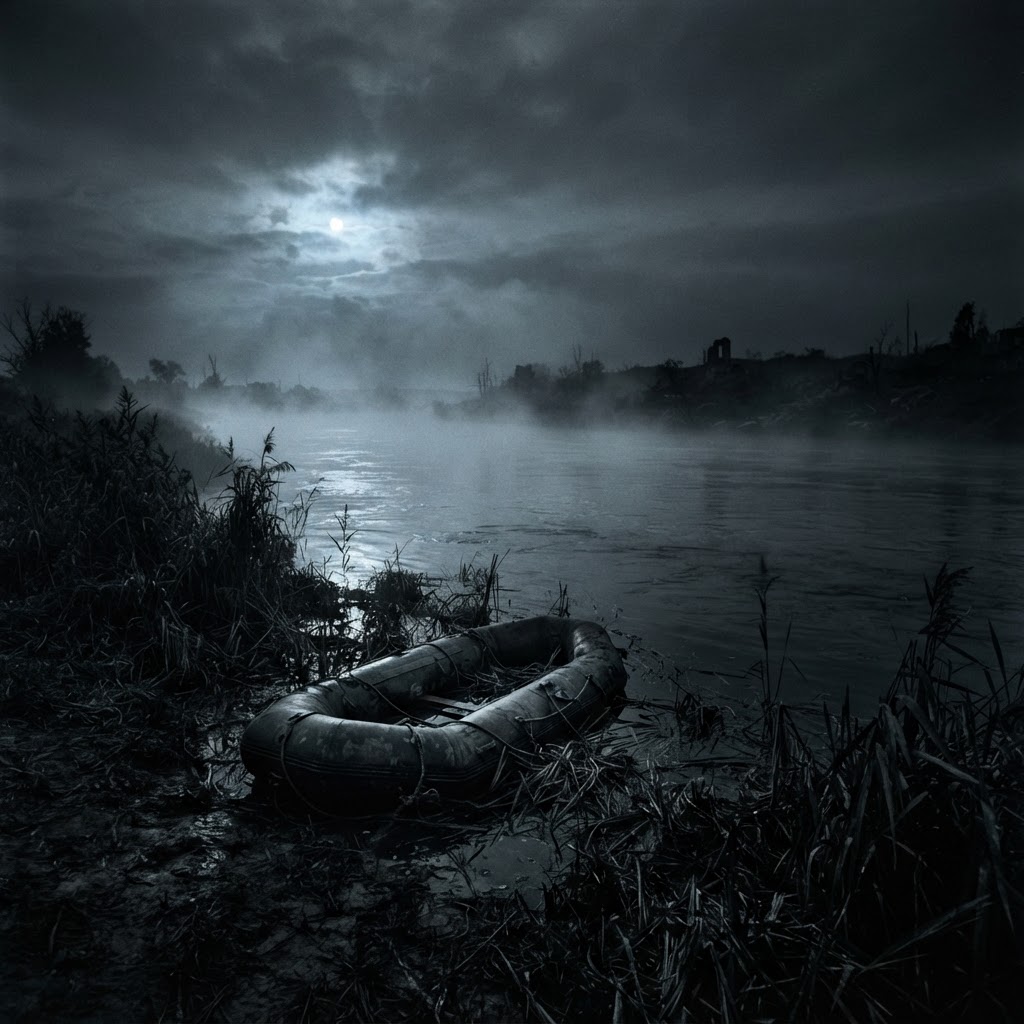
What followed over the nights of 22-23 and 23-24 September was among the most desperate improvisation of the entire campaign. The only available crossing means were a handful of small rubber assault boats — perhaps sixteen in total — provided belatedly by the 43rd (Wessex) Infantry Division, which had finally pushed close enough to make contact.
Sosabowski organised the crossings himself, standing at the river's edge in darkness while German machine guns swept the water. The rubber boats were rowed by men using rifle butts and bare hands when paddles were lost. Many boats were hit and sank. Some soldiers drowned in the cold Rhine current, weighed down by their equipment. Others made it across and crawled into the Oosterbeek perimeter, where the exhausted British survivors received them with the particular gratitude of men who have been told relief is coming so many times that they have almost stopped believing it.
Across the two nights, approximately 200 Polish soldiers crossed the Rhine. It was a fraction of what was needed. But for the men in the Oosterbeek pocket, those 200 Poles — arriving wet, armed, and ready to fight — represented something beyond their military value. They were proof that the world outside the perimeter had not simply forgotten them.
Private Jerzy Kasperek, who crossed on the second night in a boat that was holed twice by machine-gun fire and bailed out by hand, later said he had been more frightened during that crossing than at any other point in the war, including his drop earlier in the week. The boat, he remembered, was pink — inexplicably, surreally pink — and it made them feel obscenely visible in the dark water.
## The Aftermath and the Injustice
On the night of 25-26 September, the remnants of the British 1st Airborne Division were evacuated back across the Rhine under cover of darkness. Of the 10,000 men who had gone into the Arnhem operation, roughly 2,400 were evacuated. The rest were dead, wounded, or captured. The Polish brigade had lost around 25% of its strength.
What happened next was a particular cruelty. Facing pressure from the Dutch government-in-exile and seeking to deflect criticism of Market Garden's planning, Field Marshal Montgomery and his staff allowed blame for the operation's failure to settle, with deliberate unfairness, on Sosabowski. He was characterised as difficult, uncooperative, and insufficiently aggressive. He was relieved of his command in December 1944.
The general who had been right — who had seen the flaws that the planners had not wanted to see — ended the war without a command. He settled in London after the war, working as a factory storekeeper. He died in 1967. The Polish government, then communist, gave him no official recognition.
In 2006, the Dutch government awarded him the Military Order of William, the Netherlands' highest military honour — posthumously, sixty-two years after his men had gone into the Rhine in pink rubber boats for a battle that was already lost before they jumped.
Sosabowski was right. That is what the Rhine remembers.
Market Garden
Polish Parachute Brigade
Sosabowski
Arnhem
Operation Market Garden
AI-Generated