Historical Analysis
Blood on the Olive Groves: The Battle for Ortona, 1943
They called it the Little Stalingrad of Italy. In December 1943, Canadian soldiers fought house-to-house through Ortona's ancient streets in one of the most brutal urban battles of the entire war.
Walking in Their Footsteps
Author
October 19, 2026
6 min read
## Blood on the Olive Groves: The Battle for Ortona, 1943
December in Ortona smells of woodsmoke and sea salt, the Adriatic wind cutting through the narrow medieval streets from the east. In December 1943, it smelled of something else entirely. Cordite. Dust. Death. For twenty-seven days, the soldiers of the 1st Canadian Infantry Division fought through this small Italian port town in a grinding, savage battle that consumed entire regiments and reshaped every assumption about how modern armies fight in cities. The Germans called it a *Stalingrad in miniature*. The Canadians who survived it simply called it Ortona, and they said the word quietly, the way men say the names of things they cannot fully explain.
---
## The Road to Ortona
By late autumn 1943, the Allied advance up the Italian peninsula had already lost its early optimism. The Italian Campaign, launched with such hope after the fall of Sicily in July, had congealed into something slow and bloody. The Germans, under Field Marshal Albert Kesselring, had constructed a formidable defensive line — the Winter Line, anchored by the Gustav Line further south — and were making the Allies pay for every kilometre.
On the Adriatic coast, the task of cracking through fell largely to the 1st Canadian Corps. Their objective was the town of Ortona, perched on a promontory above the sea, its medieval castle and narrow streets forming a natural fortress. The Germans defending it were no ordinary garrison. The 1st Parachute Division — the *Fallschirmjäger* — were among the finest soldiers in the German army: battle-hardened, fanatical, and expert in defensive fighting.
The Canadians arrived at the outskirts of Ortona on December 21, 1943, having already fought their way across the Moro River in bitter combat that had cost the Royal Canadian Regiment and the Hastings and Prince Edward Regiment grievous casualties. They expected to take Ortona quickly. They were wrong.
---
## Mouseholing Through Hell
Ortona's streets were too narrow for tanks to operate effectively. The Fallschirmjäger had blocked roads with demolished buildings, turned every house into a strongpoint, and rigged booby traps with a grim inventiveness that astonished even experienced Allied soldiers. A staircase might conceal a pressure mine. A seemingly abandoned room could collapse when entered, the ceiling pre-loaded with charges.
The Canadians adapted with improvised brilliance. They developed a technique called *mouseholing* — blasting holes through shared walls between houses, moving from building to building without ever stepping into the lethal open street. A team would fix a explosive charge to the wall, blow a man-sized gap, and push through before the dust settled, clearing room by room with grenades and Tommy guns. It was exhausting, terrifying, claustrophobic work.
The Loyal Edmonton Regiment and the Seaforth Highlanders of Canada bore the brunt of the fighting inside the town. Their war diary entries from those days read like dispatches from another world: *"C Company engaged in house-to-house fighting all day. Three NCOs killed. Unable to recover bodies until dark."* The 90th Anti-Tank Battery provided direct fire support, their guns inching forward to blast strongpoints at near point-blank range.
Corporal Roy Boyd of the Loyal Edmontons described it later: *"You'd blow a hole in a wall, throw a grenade through, wait for the bang, then go. And in the next room there might be nobody. Or there might be four of them waiting. You never knew."*
---
## Christmas in a Cathedral
On Christmas Day, 1943, the Seaforth Highlanders of Canada organised something extraordinary. In the shattered Church of Santa Maria di Costantinopoli — partially destroyed, its roof open to the winter sky — they held a Christmas dinner. Cooks had prepared roast pork, vegetables, and Christmas pudding. Soldiers rotated off the line in small groups, ate in silence or in something approaching wonder, and rotated back. Outside, the battle continued.
The gesture was both defiant and desperately sad. Some of the men who ate Christmas dinner that day were dead before the new year. But the image endured: Canadian soldiers, filthy and exhausted, sitting in a bombed church with forks in their hands, observing Christmas in the middle of a battle that seemed to have no end.
---
## The Last House
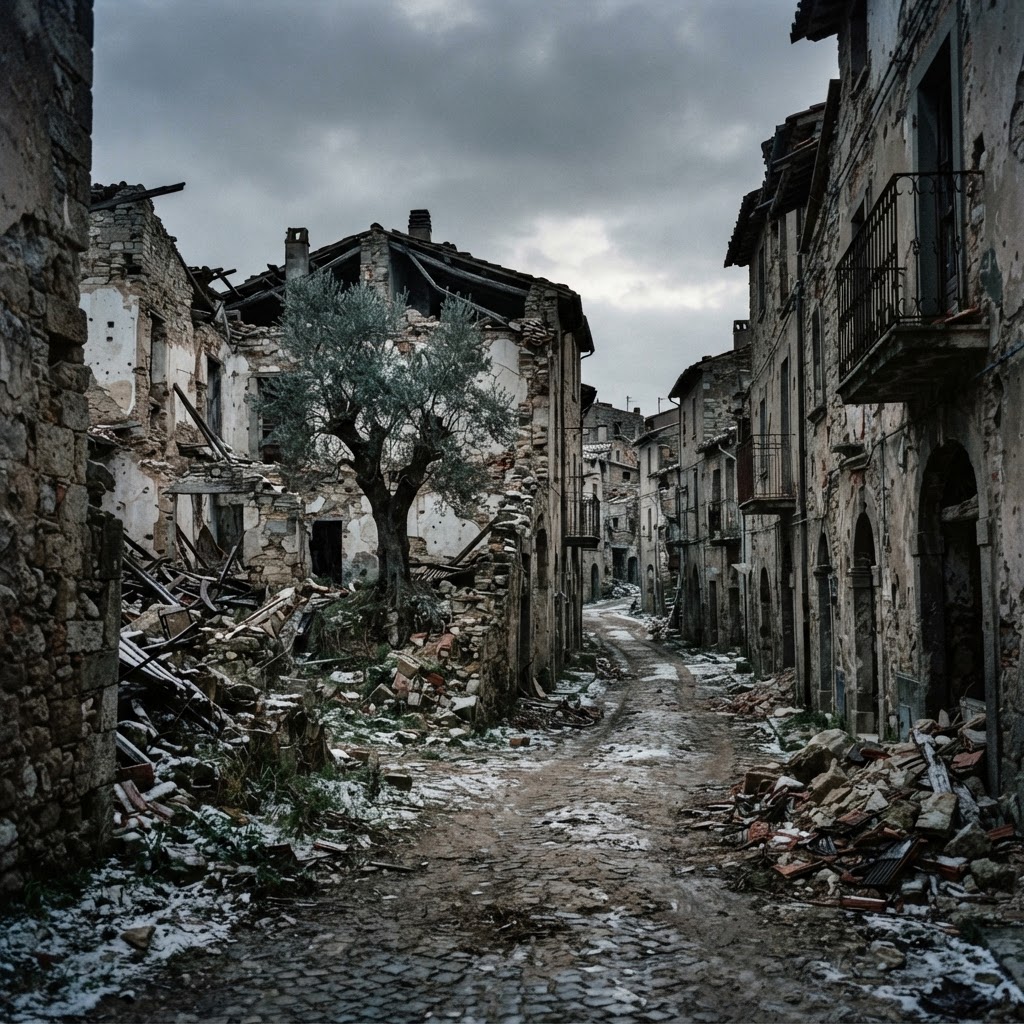
Ortona finally fell on December 28, 1943. The Fallschirmjäger withdrew not because they were defeated outright but because holding the town had become strategically untenable — the Canadian pressure relentless, the cost prohibitive even for elite troops. The town they left behind was barely recognisable. Entire blocks had been demolished. The famous Piazza Municipale was a field of rubble.
The Canadians had suffered over 650 killed and more than 1,700 wounded in the Ortona fighting and the preceding Moro River battles. The Fallschirmjäger losses were never precisely recorded, but they were severe.
---
## A Town That Remembers
Ortona today is a quiet, sun-warmed town on the Adriatic coast, its rebuilt streets giving little immediate indication of what happened there. But look carefully. The Moro River Canadian War Cemetery lies just south of the town — 1,375 Canadians buried in neat rows above the sea. Every December, Ortona holds a commemoration. The Seaforth Highlanders' Christmas dinner is re-enacted in the rebuilt church.
The olive groves on the Moro River valley still grow where men died in the cold mud of 1943. Some things, the landscape remembers even when we don't.
Ortona
Italian Campaign
1st Canadian Infantry Division
Fallschirmjäger
WWII Italy
urban warfare
AI-Generated