Historical Analysis
The Night the Rangers Took Pointe du Hoc Back
They scaled the cliffs at dawn, only to face a German counterattack that nearly wiped them out. The two-day siege at Pointe du Hoc is one of D-Day's most brutal and least-told stories.
Walking in Their Footsteps
Author
October 12, 2026
6 min read
## The Climb Was Only the Beginning
Most people know the story of the climb. At 7:10 on the morning of 6 June 1944, men of the 2nd Ranger Battalion fixed grappling hooks to rocket launchers, aimed them skyward, and began hauling themselves up the sheer 30-metre cliffs of Pointe du Hoc under fire. It is one of the most visceral images of the entire Normandy campaign. But what happened next — the two days that followed — is a story far fewer people know. And it is, in many ways, the more remarkable one.
Lieutenant Colonel James Earl Rudder led 225 Rangers in the assault on Pointe du Hoc, a craggy promontory between Utah and Omaha beaches that the Allies believed housed a battery of six 155mm guns capable of devastating both landings. The climb cost them men. German defenders rolled grenades over the cliff edge, cut ropes, and raked the cliff face with machine-gun fire. Yet within fifteen minutes of the first grapple catching, Rangers were on top.
## An Empty Battery
What they found when they got there stopped them cold. The concrete casemates were empty. The guns had been moved inland weeks earlier. The Rangers had bled and climbed for a position that held no artillery — at least not yet in place. Small patrols pushed south along the road toward Vierville, and it was Sergeant Len Lomell and Staff Sergeant Jack Kuhn of D Company who found the guns: five of the six 155mm pieces, camouflaged in an apple orchard some 550 metres inland, loaded and pointed toward Utah Beach. Lomell smashed the traversing mechanisms with a thermite grenade. Kuhn disabled two more. The guns never fired a round toward the fleet. It was, by any measure, one of the most consequential acts of the entire invasion — performed by two exhausted men in a hedgerow lane without orders and without fanfare.
But Rudder's men now held a position they could barely defend. By nightfall on D-Day, of the 225 Rangers who had landed, fewer than 90 were fit to fight. Radio contact with the fleet was intermittent. The promised relief force — Rangers from the 5th Battalion — had been diverted to Omaha Beach, where the catastrophe of the first wave demanded every available man. Pointe du Hoc was on its own.
## The Counterattack
The Germans came back before dawn on 7 June. Elements of the 914th Grenadier Regiment, part of the 352nd Infantry Division, probed the Ranger perimeter through the night and hit it in force at first light. The fighting was close, savage, and confused. Rangers armed with whatever ammunition remained — and whatever German weapons they could strip from the dead — held a shrinking perimeter among the cratered moonscape of the point itself.
Rudder was wounded twice during the siege but refused evacuation. He directed his men from a command post inside one of the damaged casemates, coordinating naval gunfire support through a tenuous radio link with the destroyer USS Satterlee offshore. The Satterlee's guns proved critical: several German counterattack formations were broken up by accurate naval fire called in at almost suicidally close range to the Ranger positions.
By the afternoon of 8 June, when relief finally arrived in the form of elements of the 116th Infantry Regiment pushing out from Omaha, Rudder had fewer than 70 men still standing out of his original 225. The relief force found Rangers and German soldiers dead within metres of each other across the cratered plateau.
## What Remains
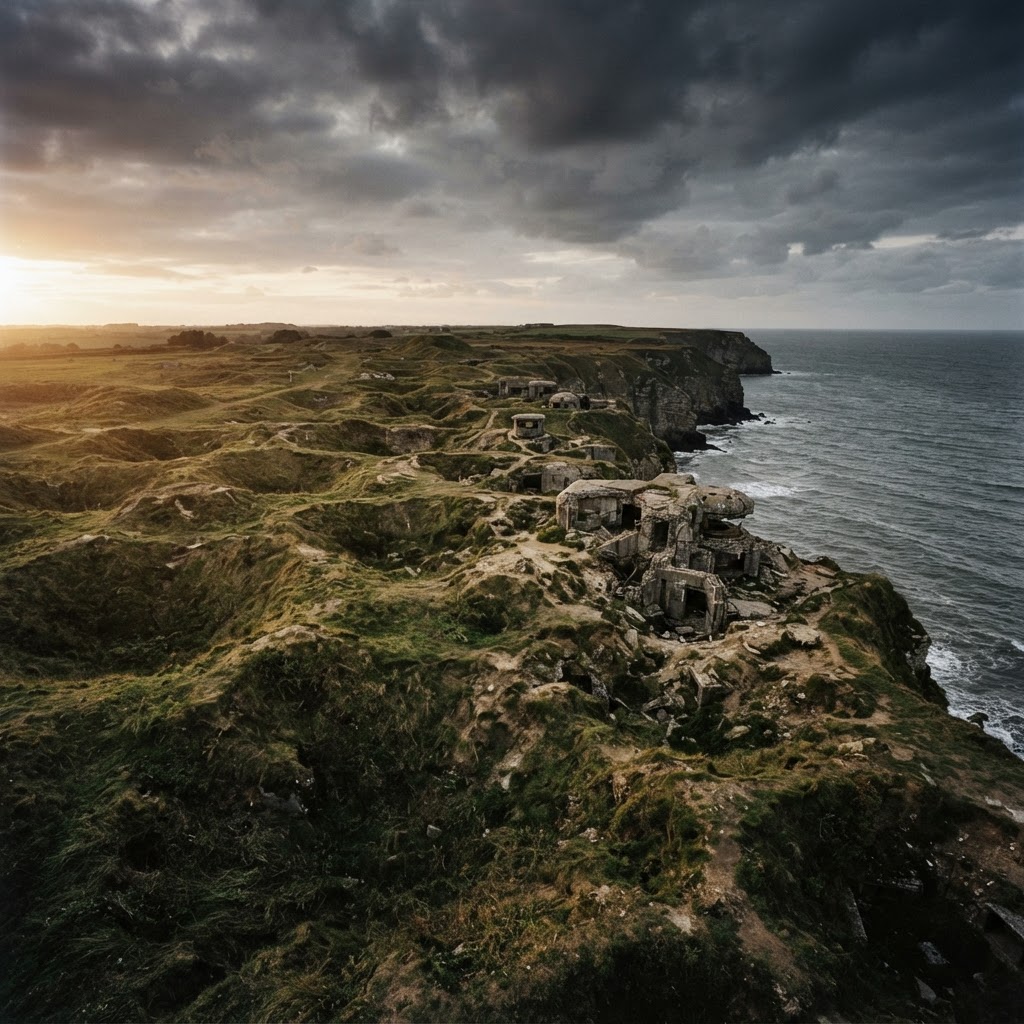
Today, Pointe du Hoc is perhaps the most immediately affecting of all the Normandy battlefield sites. The craters — formed by the massive pre-invasion bombing and naval bombardment — remain exactly as the Rangers found them, preserved deliberately by the French government and maintained by the American Battle Monuments Commission. The concrete casemates still stand, tilted and cracked, in their original positions. The cliff edge is still sheer. Standing at the lip on a grey Atlantic morning, looking down at the rocks below, the physical reality of what Rudder's men did becomes almost impossible to process.
A simple granite marker near the main casemate records that this ground was given to the United States by France in perpetual memory. Brass plaques list the dead. In the observation bunker, still intact, you can look out through the original German aperture at the same sea the defenders watched before the armada appeared.
Lomell and Kuhn both survived the war. Lomell lived until 2011, attending commemorations at Pointe du Hoc for decades, always slightly uncomfortable with the attention. He maintained to the end that he and Kuhn had simply done what needed doing. That is, perhaps, the most Ranger thing imaginable.
## A Promontory Worth Remembering Whole
Pointe du Hoc deserves to be remembered not just for the climb, dramatic as it was, but for the full arc of what happened there: the discovery of the empty casemates, the apple orchard, the two-day siege, the stubborn, costly defence of ground that had already yielded its main objective. It is a story about what soldiers do after the famous moment — when the cameras have moved on, the headlines have been written, and they are simply left to survive or not in a cratered field above the sea.
Rangers
Pointe du Hoc
D-Day
Normandy 1944
AI-Generated