Personal Stories
The SOE Agent Who Danced With the Gestapo: Noor Inayat Khan in Occupied Paris
She was a children's author and pacifist who became Britain's most vulnerable SOE agent in occupied France — and one of its most quietly heroic. Noor Inayat Khan's story deserves to be told in full.
Walking in Their Footsteps
Author
October 19, 2026
6 min read
## The SOE Agent Who Danced With the Gestapo: Noor Inayat Khan in Occupied Paris
In the summer of 1943, the Special Operations Executive's F Section — the branch responsible for inserting agents into occupied France — was in crisis. The Prosper network, one of its largest and most vital circuits in Paris, had been catastrophically compromised. Arrests were cascading through the organisation like dominoes. Every wireless operator who had been part of the network was either dead, captured, or fleeing. Except one.
Noor Inayat Khan, codenamed *Madeleine*, stayed.
---
## An Unlikely Spy
Noor's background was, by any measure, extraordinary. Born in Moscow in 1914 to an Indian Sufi musician father and an American mother, raised in Paris and London, she was a published author of children's stories inspired by ancient Indian fables. She was gentle, spiritual, and so constitutionally honest that her SOE trainers nearly failed her on the grounds that she seemed psychologically incapable of deception.
One assessment described her as *"not overburdened with brains"* and *"probably too emotional."* Another noted her remarkable courage and her absolute commitment to the Allied cause. The debate went all the way to Vera Atkins, the formidable intelligence officer who oversaw F Section's agents, who ultimately backed Noor's deployment.
She was trained as a wireless operator — a role with the shortest life expectancy of any in the SOE. In occupied France in 1943, the average survival time of a wireless operator was six weeks. Noor knew this. She went anyway.
---
## Alone in Paris
Noor arrived in France in June 1943, just weeks before the Prosper network's collapse. By August, she was the only F Section wireless operator still transmitting from Paris. London urged her to return to Britain. She refused. If she left, there would be no radio link at all — no way to coordinate supply drops, no channel for intelligence, no lifeline for any new agents who might be sent in.
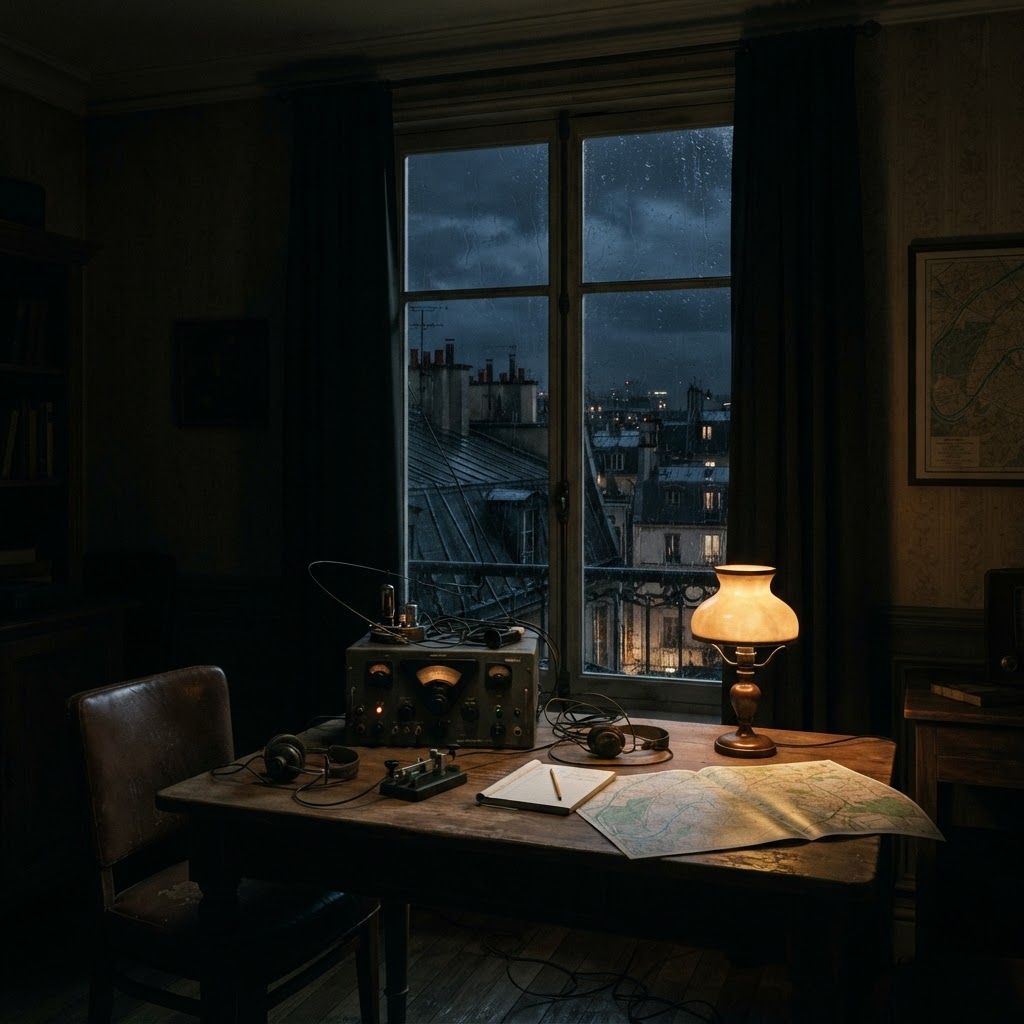
For three months, Noor transmitted from Paris under active Gestapo pursuit. The Germans had direction-finding trucks — *Funkpeilung* vans — that could triangulate a radio signal's location within minutes if the operator transmitted for too long. Noor moved constantly, changing apartments, altering her schedule, transmitting in short bursts. She changed her appearance repeatedly. She became, of necessity, the very thing her trainers doubted she could be: elusive, careful, relentless.
She carried her wireless set in a suitcase on the Paris Métro. She transmitted from borrowed apartments while German soldiers canvassed the streets below. She was stopped at checkpoints and talked her way through. She was, in the most literal sense, a woman living entirely inside a lie, sustained by a pacifist's conviction that this particular violence — the violence of information, of connection, of resistance — was worth the cost.
---
## Betrayal
In October 1943, Noor was betrayed. The identity of her betrayer remains disputed — a fellow French resister acting for money, most likely — but the result was swift. The Gestapo arrived at her apartment on the Avenue Foch. She fought back physically, biting and scratching, forcing multiple officers to restrain her. She attempted to escape twice from Gestapo headquarters, once nearly making it across the rooftops before being recaptured.
Her captors, recognising her value, attempted to turn her — to use her radio set to transmit false information back to London in a *Funkspiel*, a radio game. There is evidence she provided deliberately inaccurate information. She told the Gestapo nothing of substance about the networks she knew. After her second escape attempt, she was classified *Nacht und Nebel* — Night and Fog — the designation reserved for prisoners who were to be made to disappear without record or trace.
---
## Dachau, September 1944
Noor was held in Pforzheim prison in Germany, in solitary confinement, in chains, for ten months. Fellow prisoners later recalled hearing her being beaten. She reportedly said nothing that compromised any agent or network.
On September 12, 1944 — just weeks after Paris had been liberated, just months before the war's end — Noor Inayat Khan was transported to Dachau concentration camp with three other SOE women: Yolande Beekman, Madeleine Damerment, and Eliane Plewman. All four were executed by the SS the following morning. Noor was shot kneeling on the ground. By some accounts, her last word was *Liberté*.
She was thirty years old.
---
## The Memory She Left
Noor Inayat Khan was posthumously awarded the George Cross — Britain's highest civilian honour — and the French Croix de Guerre. A memorial bust was unveiled in Gordon Square, London, in 2012, the first memorial in Britain to a woman of Asian or Muslim heritage. A second memorial stands in Suresnes, outside Paris, near where she lived as a child.
Her story resists easy categorisation. She was not a natural spy. She was a writer, a musician's daughter, a woman who believed in non-violence and found herself in the most violent of circumstances. She stayed in Paris when every rational calculation said leave. She said nothing when silence cost her everything.
The children's stories she wrote before the war are still in print. They are gentle, full of wonder, and nothing in them prepares you for who she became.
SOE
Noor Inayat Khan
occupied France
Special Operations Executive
French Resistance
WWII women
AI-Generated