Personal Stories
The Major Who Became a Street Sign: Saint-Lô, 1944
Saint-Lô was called the 'Capital of Ruins.' But before the rubble was cleared, one American officer's final act of defiance became the city's most enduring symbol of liberation.
Walking in Their Footsteps
Author
October 19, 2026
5 min read
## The Major Who Became a Street Sign: Saint-Lô, 1944
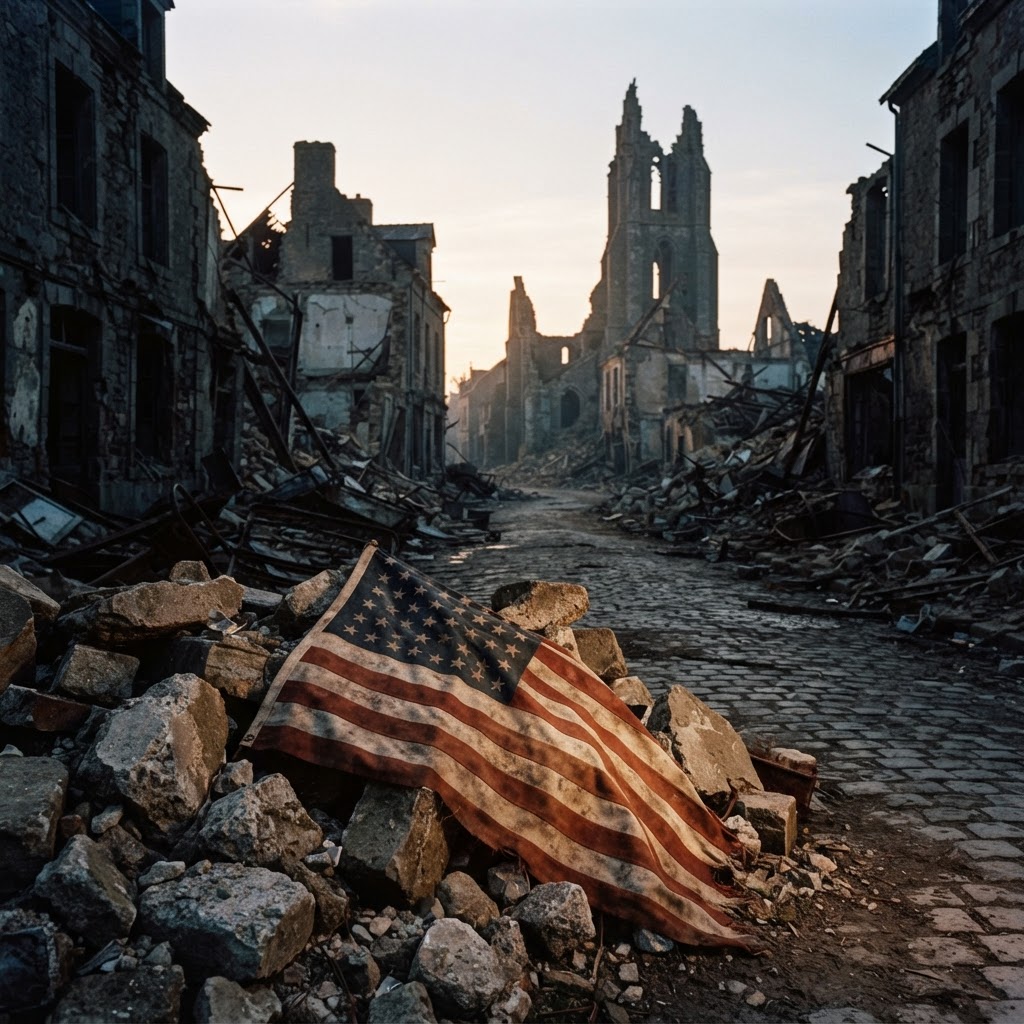
By the time American soldiers finally entered Saint-Lô on July 18, 1944, there was almost nothing left to liberate. Weeks of Allied bombing and German artillery had reduced the ancient Norman city to a moonscape of broken stone and smouldering timber. Samuel Beckett, who would later win the Nobel Prize for Literature, described what remained as "the capital of ruins" — a phrase that stuck. But amid the devastation, one name endured. Not carved into a monument. Not inscribed on a plaque. It was nailed, in hand-painted letters, to a post driven into the rubble of a shattered gateway.
That name was Major Thomas D. Howie.
---
## A Teacher Who Became a Soldier
Thomas Dry Howie was not, by profession, a warrior. Before the war he had been a high school English teacher and football coach in Staunton, Virginia — a quiet, bookish man who read poetry and believed in his students. When the United States entered the war, Howie was commissioned into the 116th Infantry Regiment, 29th Infantry Division, the same regiment that had bled so catastrophically on Omaha Beach on June 6, 1944.
By July 1944, the 29th Division was grinding through the bocage — the dense, hedgerow-laced countryside of Normandy that turned every field into a fortress. Progress was measured in yards. Casualties mounted with awful regularity. Howie, commanding the 3rd Battalion, had earned a reputation as a calm, decisive leader — a man who led from the front and kept his composure when everything around him was chaos.
On July 17, the 29th Division received orders to capture Saint-Lô as part of the broader American effort to break out of the Normandy beachhead. Howie's battalion was tasked with pushing through the suburb of Martinville to relieve the encircled 1st Battalion and open the road into the city.
---
## The Morning It All Changed
At 0430 on July 18, Howie's men moved out through the pre-dawn darkness. The advance was difficult — German resistance was fierce, the terrain unforgiving. But they broke through. The link-up with the battered 1st Battalion was achieved. The road to Saint-Lô was open.
Howie radioed his commanding officer, Brigadier General Norman Cota, with a message as simple as it was triumphant: *"Will be in Saint-Lô in an hour."*
He never made it.
Minutes after that transmission, a German artillery round landed near Howie's position. The blast was instantaneous and merciless. Thomas Howie was killed outright — never seeing the city he had fought so hard to reach.
---
## The Gesture That Became a Legend
General Cota, deeply moved by Howie's death and his soldiers' grief, made a decision that was equal parts military honour and human feeling. He ordered that Howie's body — draped in an American flag — be carried into Saint-Lô at the head of the liberating column. The Major would enter the city after all.
Howie's flag-draped body was placed atop a jeep and driven through the ruins to the remnants of the Church of Sainte-Croix, where it was laid on a pile of rubble. There, a handmade sign was posted: *"Major Thomas D. Howie, The Major of Saint-Lô."*
Photographs of the moment — the flag-covered body amid the devastation, the hand-lettered sign, the hollow eyes of exhausted soldiers — were transmitted to newspapers across the United States. Howie's face never appeared in the famous images. He was anonymous in death, representing every soldier who had died in the bocage. *Time* magazine ran the photograph. The story spread. The Major of Saint-Lô became, briefly, the most famous casualty of a campaign full of them.
---
## What the Ruins Remembered
Saint-Lô was rebuilt after the war — painstakingly, methodically, in the way that shattered French towns were rebuilt across Normandy. New streets were laid. New buildings rose. But the city did not forget Thomas Howie.
Today, the Memorial to the Major of Saint-Lô stands near the site where his body was laid. A bronze bust of Howie marks the spot, and the town has named streets and institutions in his memory. The 29th Infantry Division's ties to the city remain strong — a transatlantic bond forged in rubble and grief.
Howie's story endures not because he performed some extraordinary feat of arms, but because of the very ordinariness of his heroism. He was a teacher. He was careful, and kind, and good at his job. He sent a radio message saying he'd be somewhere in an hour, and then he was gone. That gap — between the message and the silence — is where his legend lives.
---
## Visiting Today
The memorial in Saint-Lô is modest and deeply moving. The bust looks out over a city that was rebuilt from almost nothing — which is, in its own way, a monument too. If you stand there on a quiet morning, in the shadow of the restored church towers, it is not difficult to imagine the column of exhausted men, the flag-draped jeep, and the hand-lettered sign that turned a dead English teacher from Virginia into the enduring symbol of a city's liberation.
His students back in Staunton grew old. The hedgerows of the bocage are still there. And in Saint-Lô, the Major's name is still on the map.
Saint-Lô
29th Infantry Division
Thomas Howie
Normandy liberation
D-Day
bocage fighting
AI-Generated