Personal Stories
The Ranger Who Scaled Pointe du Hoc Twice
At dawn on 6 June 1944, Lieutenant Colonel James Rudder's 2nd Ranger Battalion clawed up a 30-metre cliff under fire. What they found at the top would haunt them for decades.
Walking in Their Footsteps
Author
September 21, 2026
6 min read
## The Cliff That Should Have Stopped Them
The ropes were wet. The grappling hooks, soaked by sea spray and the wash of the landing craft, fell short on the first throws. Above them, German soldiers peered over the lip of Pointe du Hoc and cut the lines, or simply dropped grenades down the face. Below, men of the 2nd Ranger Battalion clung to whatever purchase they could find, suspended between the grey English Channel and a clifftop bristling with defenders. It was approximately 0710 on 6 June 1944, and Lieutenant Colonel James Earl Rudder had already watched his command shrink by a third before a single Ranger reached the top.
Pointe du Hoc was the most dangerous assignment of D-Day. Intelligence had identified six 155mm artillery pieces positioned on the headland, capable of ranging both Omaha and Utah beaches simultaneously. Left intact, they threatened every vessel in the invasion fleet. SHAEF planners were blunt: the guns had to be silenced by 0630, or the entire landing timetable unravelled. The job fell to Rudder and roughly 225 men of the 2nd and 5th Ranger Battalions.
## Fifteen Minutes Late, and Already Bleeding
The approach had gone wrong almost immediately. Navigation errors pushed Rudder's flotilla eastward along the coast, forcing a correction run under fire from German shore positions. They arrived at the base of the cliff fifteen minutes behind schedule — fifteen minutes during which the preliminary naval and aerial bombardment had ceased, giving the defenders time to regroup.
What followed was a feat of improvised violence. Where grappling hooks failed, Rangers used toggle ropes and their own fingers in the chalk face. Where ladders supplied by the London Fire Brigade buckled under fire, men formed human chains. Private First Class Harry Roberts of C Company later recalled that he climbed the first eight metres before he even registered that the man directly below him had been shot off the rope. You didn't look down. You couldn't afford to.
Rudder himself was among the first wave to reach the top. He was wounded twice during the assault — once in the leg, once in the arm — and refused evacuation both times. He established his command post in a shell crater at the cliff's edge and directed the fight from there for the next two days.
## The Guns Were Gone
The first Rangers to reach the casemates found them empty. The feared 155mm pieces had been moved inland before the invasion, repositioned to a camouflaged orchard approximately 1.5 kilometres south. It was a discovery that could have broken morale entirely. Instead, Sergeant Len Lomell and Staff Sergeant Jack Kuhn of D Company followed tyre tracks through the bocage and found all five operational guns — the sixth had been damaged — positioned and ready to fire, their crews absent. Lomell disabled two with thermite grenades. Kuhn returned with more grenades. Within minutes, all five guns were out of action.
The mission had succeeded. But the Rangers were now isolated, holding a cratered wasteland against repeated German counterattacks, with no reinforcement and dwindling ammunition. For two days and two nights, Rudder's force — reduced to fewer than ninety effectives — held the point. Relief finally arrived on 8 June. Of the 225 men who had landed at the base of the cliff, 77 were still standing.
## What the Crater Field Remembers
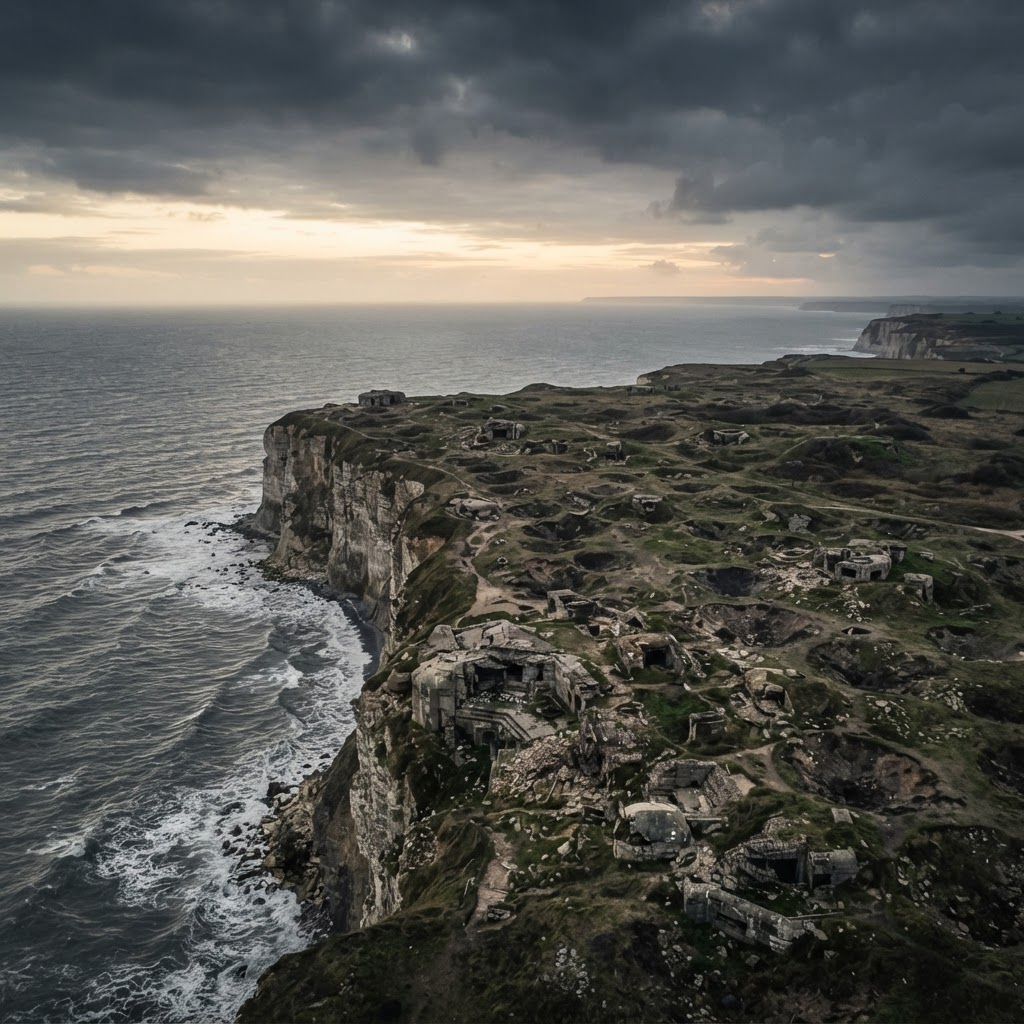
Today, the surface of Pointe du Hoc looks much as it did in June 1944. The bomb craters have never been filled. The concrete casemates still stand, fractured and grey, overlooking a sea that has forgotten nothing. The site is preserved by the American Battle Monuments Commission, and it remains one of the most visceral battlefield landscapes in all of Normandy — a place where the violence of that morning is written into the earth itself.
James Rudder survived the war, rose to the rank of Brigadier General, and later became President of Texas A&M University. He returned to Pointe du Hoc in 1954 for the dedication of the Ranger monument, standing at the edge of the same cliff he had scaled a decade earlier. By all accounts, he said very little. There was nothing the landscape hadn't already said.
Lomell and Kuhn, the two sergeants who had disabled the guns, received the Distinguished Service Cross. Lomell later described the moment he found the battery as the most important two minutes of his life. Given what those guns might have done to the men wading ashore at Omaha and Utah, it is difficult to argue with him.
## Standing at the Edge
Visiting Pointe du Hoc today, it is the silence that strikes you first. The Atlantic wind off the headland, the uneven ground underfoot, the way the craters make ordinary walking an act of concentration — it all conspires to slow you down, to make you stop and look. The Ranger monument, a simple granite pylon, stands near the main casemate. An American flag flies above it.
The cliff is still there. It is still thirty metres high. And standing at its base, looking up at the chalk face with the wind in your ears, the question is not how they did it. The question is simply: why would anyone?
The answer, of course, is that someone had to. And on 6 June 1944, it fell to Rudder's Rangers.
2nd Rangers
Pointe du Hoc
James Rudder
D-Day
Normandy
Len Lomell
AI-Generated